


Most business owners don’t fail because they lack skill. They struggle because they don’t have financial clarity at the right time. In the early days, you can get away with doing everything yourself, tracking expenses, filing taxes, and guessing at profits.
But eventually, something breaks:
You owe way more in taxes than expected
Your books are a mess
Cash flow feels unpredictable
You don’t actually know if you’re profitable
And when that moment hits, most owners ask:
“Do I need a bookkeeper? A CPA? A tax person?”
The real answer is:
You need different financial help at different stages of your business.
This is the financial growth ladder, and I am overjoyed to take you through it. If something doesn’t stand out or you have further questions, you can always comment below for an answer!

The 4 Types of “Accountants” (And What They Actually Do)
Before we talk about stages, we need to clear something up: not all “accountants” do the same thing. In fact, some do only one of these, while others, like my firm, do several!
1. The Bookkeeper — The Record Keeper
A bookkeeper is responsible for:
Categorizing transactions
Reconciling bank accounts
Keeping QuickBooks clean
Producing monthly reports
They do not:
Do an advanced tax strategy
Represent you to the IRS
Help you make big financial decisions
A bookkeeper makes sure your numbers are accurate. and you get the basic reports you need to understand business health but they do not typically perform forward thinking financials only look at the past numbers.
*This is by far the first support many business owners need in their business, or at least take free training on. If you are just starting in your business, please, please go find some videos or QuickBooks courses to learn how to properly keep your books.
2. The Tax Preparer — The Filer
A tax preparer:
File your tax return for your business or personal returns
Ensures compliance
Have an IRS PTIN number and sometimes an EFIN (passed background check and their business can electronically transmit returns)
Helps you avoid filing mistakes
Is Unlicensed (EAs and CPA’s are the federal version of licensed tax professionals)
They often:
Work seasonally
Are dual-purpose (Insurance agents, Immigrant support offices, etc.)
Focus on filing, not strategy
Are unlicensed, so cannot represent you in front of the IRS
Will not help you with forward-thinking tax strategy (but some will)
A tax preparer helps you stay compliant—but not necessarily optimized. In fact if you find a Tax preparer who will act like the roles below for tax strategy then i can almost gurentee they will become either an EA or CPA soon! Many Stay here and set up bandit signs, some want better and become/Earn the roles below.
*Some states, such as California, require even unlicensed preparers to take a course or other form of training or insurance, but most require nothing beyond an IRS PTIN to perform tax preparation services.
3. The Enrolled Agent (EA) — The Tax Strategist
An EA is licensed by the Internal Revenue Service.
They can:
File taxes
Provide a tax strategy
Represent you before the IRS
Handle audits and tax issues
Do everything a CPA can do in the tax world; they are tax-specific specialists who work hard and take several federal exams to get their License.
Can prepare Tax Returns in all 50 states.
An EA is a tax specialist who helps you reduce taxes and solve problems. This is the highest Tax specific license in the country.
*This is the exact license I am working on this year, and one any real preparer strives to be. Many think CPAs are the only good tax people to go to; wrong. EAs can do everything a CPA can do before the IRS, and while a CPA is a very hard and high achievement, it is a rounded Accountant license; EAs are licensed specifically in Taxes.
4. The CPA — The Financial Expert
A CPA can do everything an EA does, plus:
Financial reporting
Audits
High-level advisory
Complex structuring
They’re typically used by:
Larger businesses
Companies with investors
Businesses needing formal financials
A CPA is the most advanced but not always necessary early on.
* There are CPAs at so many different levels. There are some that are discount services and some that won't serve clients who make less than 1 million per year. Everyone should strive to the point where they need a CPA to run their business, and by this point, you probably need someone to become a fractional CFO. Meaning someone who runs your business inside and out financially and can give you real, forward-thinking advice.
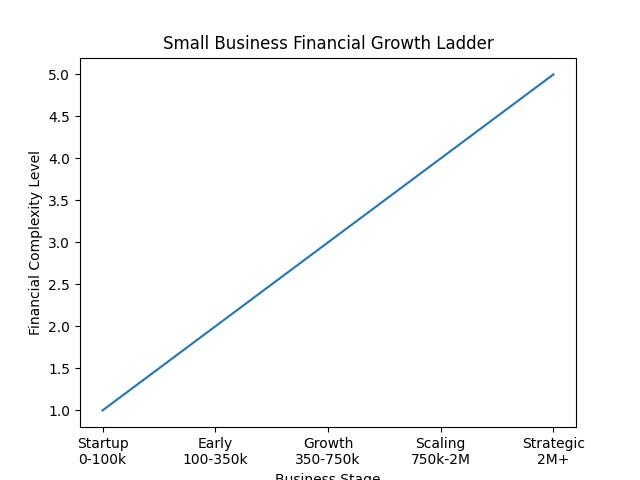
The Small Business Financial Growth Ladder
Every business moves through predictable stages.
As revenue grows, financial complexity increases, and so should your financial support. But be careful: at each stage, it may be tempting to spend on the next; make sure you are consistent in revenue before making the jump.
Also, all of the stages below are things I have gone through or have seen my clients experience.
Stage 1: Startup ($0 – $100k)
At this stage:
You’re doing everything yourself
You may be using spreadsheets
Transactions are simple
Your biggest risks:
Filing taxes incorrectly
Missing deductions
Disorganized finances
Who you need:
Tax preparer (minimum)
Optional basic bookkeeping (I recommend any free training you can find online and a good bookkeeping software like QuickBooks)
At this level, survival matters more than optimization.
Stage 2: Early Revenue ($100k – $350k)
This is where things start breaking.
You’ll notice:
Your books are messy
You don’t trust your numbers
Tax season gets stressful
You’re guessing at profits
You are bleeding money somewhere, potentially unknown to you
Who you need:
Bookkeeper (non-negotiable)
Experienced Tax Preparer, preferably an EA
Why:
Clean books start saving you money and time.
Once you cross $100k, guessing is no longer sustainable. I also advise you to seek advice from Your Tax Person to advise on wether S Corp status makes sense (it probably does but you need to do it right and be guided)
Stage 3: Growth Stage ($350k – $750k)
Now your business is real and expensive.
You’ll feel:
Higher tax bills
Confusion about structure (LLC vs S-Corp), if not addressed already, or feeling the pain from bad choices earlier in your career.
Questions about how to pay yourself
Possibly paying yourself too much or not enough
High need for a real tax plan to avoid those high IRS bills
Who you need:
Bookkeeper
Tax advisor (EA or CPA)
This is where strategy begins.
At this level, tax planning can save thousands sometimes tens of thousands.
Stage 4: Scaling Business ($750k – $2M)
This is where complexity explodes.
You’re dealing with:
Payroll
Cash flow pressure
Hiring decisions
Growth planning
Who you need:
Bookkeeper
EA or CPA
Fractional CFO / controller-level support (this means whoever you use needs to be meeting with you at a minimum monthly, tax advising quarterly, and showing you all your blind spots)
What changes here:
You stop asking:
“Did I make money?”
And start asking:
Where is my money going?
How do I continue to scale profitably?
Who do I need to hire?
Around $1M, financial strategy becomes just as important as sales. you cannot get past the next barrier making the financial mistakes you were before. You need a plan and a good one at that.
Stage 5: Strategic Business ($2M+)
At this level:
You’re optimizing, not surviving
Decisions have a bigger financial impact
Growth is intentional
potentially looking at selling the business or an exit strategy
Who you need:
Full financial stack
CPA
CFO-level leadership
You need all stops pulled
Finance becomes a competitive advantage. Are you building to sell or exit? How does that look for your life? Should you start buying some competitors legally or looking at buying buinsesses that can support activities in your current business? I could write a whole articel alone on this stage.
The Mistake Most Owners Make
They hire the wrong help at the wrong time.
Examples:
Hiring a CPA when they just need clean books
Using only a tax preparer when their books are a mess
Waiting too long to get strategic help
The correct order is:
Clean books
Tax strategy
Financial leadership
If you skip step one, everything else breaks.
What This Looks Like in Practice
To make this more tangible, here’s an example of how financial support is often structured as a business grows.
This is based on how I currently organize my own service levels, but more importantly, it reflects what many small businesses naturally need at each stage.
Level 1 — Bookkeeping (Foundation)
Typical revenue range: $100k–$350k
At this stage, the focus is on:
Keeping books clean and up to date
Monthly reconciliations
Reliable financial reports
This level is about building a foundation.
If your numbers aren’t accurate, nothing else works.
Level 2 — Bookkeeping + Tax Strategy
Typical revenue range: $350k–$750k
As the business grows, support usually expands to include:
Ongoing bookkeeping
Basic tax planning throughout the year (not just filing)
Guidance on things like estimated payments and structure
At this level, businesses are no longer just tracking money; they’re starting to manage it more intentionally.
Level 3 — Bookkeeping + Strategy / CFO-Level Support
Typical revenue range: $750k–$2M
Once complexity increases, businesses often need:
Deeper financial analysis
Cash flow planning and forecasting
Regular financial check-ins or strategy discussions
Help with making higher-level decisions
At this point:
The numbers become a tool for decision-making not just a record of what already happened.
Why this matters:
Most business owners don’t need everything from day one.
But they do need the right level of support for their current stage.
And as the business grows, that level naturally evolves.
Final Thought
Every business eventually becomes a finance business.
Not because you want it to
But because:
Cash flow determines survival
Taxes determine profitability
Decisions determine growth
The businesses that win in the long term aren’t the ones that avoid financial help.
They’re the ones that bring in the right help at the right time.